
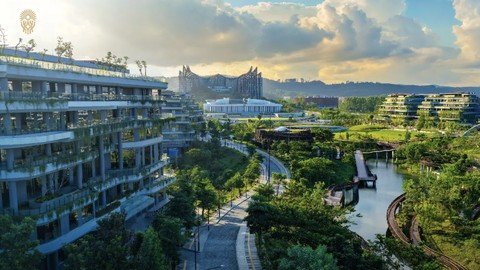
Plaza Seremoni in Nusantara receives an Honour Award at the Malaysia Landscape Architecture Awards 2026, highlighting Indonesia’s approach to sustainable urban development.
NUSANTARA — Indonesia’s Nusantara is receiving international attention for its approach to public-space and landscape development after Plaza Seremoni was awarded an Honour Award at the Malaysia Landscape Architecture Awards (MLAA) 2026 in the Landscape Design Award, Professional Category. The recognition places a major public space within Indonesia’s new capital in a broader Southeast Asian conversation on sustainable urban development.
According to the Nusantara Capital Authority, the award recognizes the landscape design of Plaza Seremoni, which combines aesthetic considerations, public-space functions and principles of sustainable development. The official MLAA winners list also places Plaza Seremoni among the international projects receiving an Honour Award in the professional landscape design category.

The recognition is significant in the ASEAN context, where cities are increasingly facing the need to accommodate economic growth while maintaining environmental quality and creating inclusive public spaces. Urban development across the region is gradually moving beyond conventional infrastructure provision toward approaches that integrate mobility, landscape, ecological resilience and quality of life.
Plaza Seremoni forms part of the Sumbu Kebangsaan area and is located in front of the State Palace and Garuda Palace in Nusantara. Rather than functioning solely as a ceremonial setting, the area has been designed as a public space where governmental activities can coexist with social, cultural and recreational activities.
The development includes an open-air amphitheatre, pedestrian and cycling paths, green areas, an MSME gallery and communal spaces. Such facilities reflect an approach in which public infrastructure is expected to serve multiple functions and encourage interaction among residents and visitors.
The landscape concept also takes into account the natural characteristics of the site. The use of the existing land contours and water-management systems forms part of the strategy to maintain environmental balance while creating a distinctive identity for Nusantara.
For Basuki Hadimuljono, Head of the Nusantara Capital Authority, the development of Nusantara is built around three principles: quality, aesthetics and sustainability. His statement underlines an approach in which construction progress is considered alongside the quality of the resulting urban environment.
The three principles are particularly relevant as ASEAN cities seek development models that can remain functional over the long term. Rapid urbanization creates pressure on land, transportation, natural resources and public infrastructure, making the integration of environmental considerations into city planning increasingly important.
Nusantara’s development also incorporates the concept of a forest city. The authority has highlighted ecological restoration and rewilding as part of its broader approach to developing the new capital. The objective is not simply to introduce green elements into an urban environment, but to integrate ecological functions into the structure of the city.
The recognition from Malaysia also illustrates the regional nature of landscape architecture and urban-development practices. The MLAA 2026 international category included projects from Indonesia, Singapore, Thailand and other locations, providing a regional platform for comparing different approaches to landscape design and public-space development.
For Indonesia, the award provides an opportunity to demonstrate how a new capital can incorporate public spaces into a broader vision of urban development. For ASEAN, it adds another example of how cities can explore development models that combine government functions, public life and environmental considerations.
The next stage will be measured not only by international recognition but also by how these spaces perform over time. Accessibility, maintenance, environmental resilience, public use and the ability to support everyday urban activities will ultimately shape the long-term value of Plaza Seremoni and Nusantara as a developing city.
As Southeast Asia continues to urbanize, the experience of Nusantara may offer another reference point for discussions about sustainable capital-city development. Plaza Seremoni’s recognition therefore represents more than an architectural or landscape award; it reflects the increasingly regional nature of ideas about how future cities should be designed and experienced.