
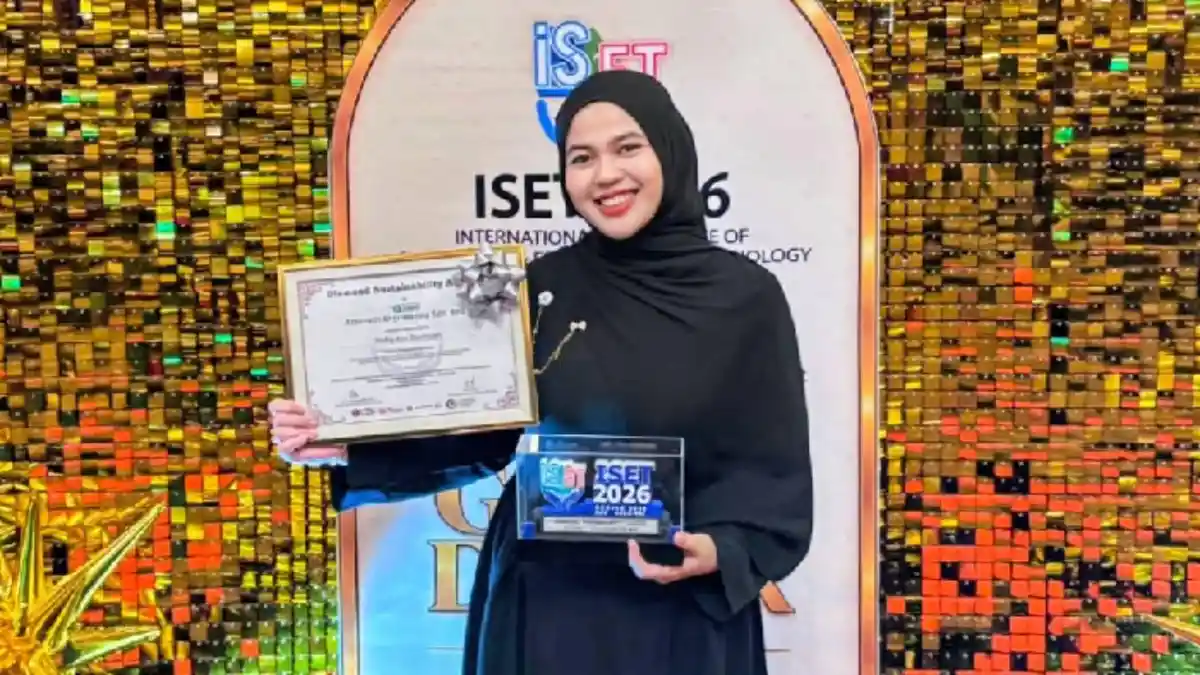
Aceh researcher Wafiq Alni Dzulhijjah receives international recognition for turning Sigupai rice husk waste into advanced materials for sustainable technology.
A local rice variety from Aceh, Indonesia, is finding a new place in conversations about sustainable technology. Sigupai rice husk, traditionally regarded as an agricultural residue, has become the focus of research into advanced materials and environmental applications led by researcher Wafiq Alni Dzulhijjah.
Wafiq, a doctoral researcher at Universitas Syiah Kuala’s School of Engineering, has been working on research related to membrane technology, water purification, and water and wastewater treatment. Her research profile reflects a broader effort to connect material science with environmental challenges.

The work gained international attention when Wafiq received the Diamond Sustainability Award 2026 at the International Conference of Sustainable and Environmental Technology 2026 (ISET 2026), held in Johor Bahru, Malaysia, from 22 to 24 September 2026. The recognition was associated with her research involving Sigupai rice husk and advanced membrane technology.
The recognition is particularly relevant in the ASEAN context, where agriculture remains an important part of many national economies while environmental pressures continue to encourage more efficient use of resources.
Rather than treating agricultural residues solely as waste, researchers are increasingly examining how these materials can be converted into higher-value products. In the case of Sigupai rice husk, research has explored its potential as a source of nanosilica and nanocellulose.
A 2025 study published in Case Studies in Chemical and Environmental Engineering examined the synthesis and characterization of nanosilica derived from Sigupai rice husk waste. The research demonstrated the potential of this locally sourced agricultural residue as a raw material for nanoscale silica production.
Further research has examined nanocellulose extracted from Sigupai rice husk through acid hydrolysis. Nanocellulose is being investigated internationally for applications in sustainable materials, including composites and packaging, giving agricultural residues a possible role in emerging material technologies.
Another line of research has investigated rice-husk-derived nanosilica and nanocellulose as antifouling agents in thin-film nanocomposite membranes. Such research is relevant to water-treatment technologies because membrane fouling is one of the challenges associated with membrane performance and operational efficiency.
These developments illustrate an important principle in the circular economy: materials that have limited value at the end of one production process may become useful inputs for another.
For ASEAN economies, this approach has particular relevance. The region has extensive agricultural activity and diverse biological resources, creating opportunities for research that combines local raw materials with advanced processing technologies.
The Sigupai case also demonstrates the importance of local biodiversity and agricultural heritage in scientific research. A traditional rice variety can become more than an agricultural product when its by-products are studied as potential feedstock for modern materials.
At the same time, international recognition should be viewed as one stage in the research journey rather than evidence that a technology is already commercially mature. Moving from laboratory research to wider application requires additional validation, consistent raw-material supply, process optimization, economic assessment, and scale-up.
For researchers working across Southeast Asia, this transition can also create opportunities for collaboration. Universities, research institutions, technology developers and industries can potentially work together to determine whether locally sourced agricultural residues can meet the technical and economic requirements of larger-scale applications.
Water technology is another area where such research may have broader regional relevance. Many ASEAN communities face continuing challenges related to clean water, wastewater management and environmental sustainability, making research into more effective and sustainable treatment materials an area of continuing scientific interest.
The significance of Wafiq’s work therefore extends beyond the story of a single award. It highlights how research rooted in a specific locality can enter a wider regional conversation about resource efficiency, sustainable materials and environmental technology.
From Aceh Barat Daya to an international scientific forum in Malaysia, the journey of Sigupai rice husk demonstrates how local resources can become starting points for scientific exploration.
As ASEAN continues to develop its sustainability agenda, research such as this offers another perspective: sustainable innovation does not necessarily begin with sophisticated industrial feedstocks. It can also begin with agricultural residues that have long been present in local communities.
The challenge ahead is to continue transforming scientific findings into validated technologies while maintaining the principles of sustainability and resource efficiency that inspired the research in the first place.
For Aceh, the story represents international visibility for research based on a local resource. For the wider ASEAN community, it offers a reminder of the scientific possibilities that can emerge when local knowledge, university research and environmental technology are brought together.