
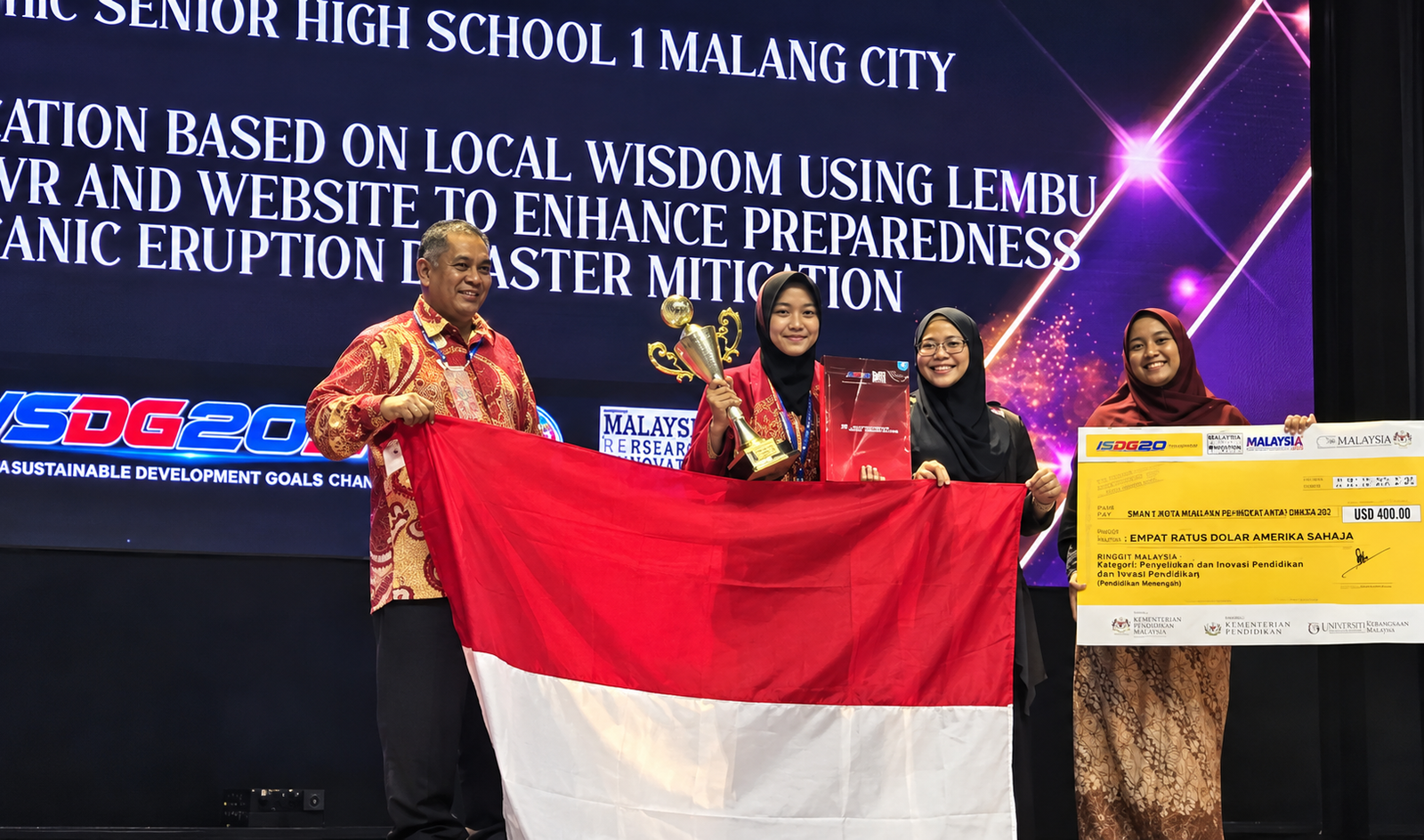
MAN 1 Kota Malang student Griselda Nuria Alisha earns international recognition in Malaysia with DJOGOSURO, combining local wisdom, digital technology and volcanic disaster preparedness.
An Indonesian student has brought a locally rooted approach to disaster preparedness onto an international stage through an innovative combination of cultural heritage and digital technology.
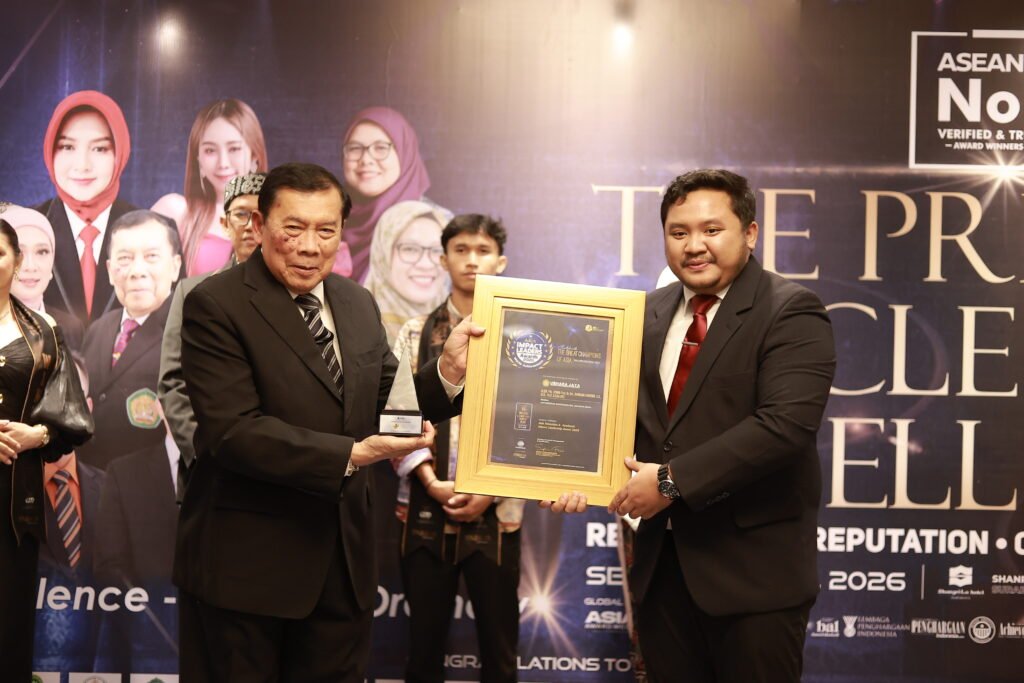
Griselda Nuria Alisha, a Grade 12 student of MAN 1 Kota Malang, received the MMU President’s Excellence Award – 2nd Runner-Up at the World Sustainable Development Goals Challenge (WSDG) 2026 in Malaysia. She represented her school as an individual participant through a project titled “DJOGOSURO: Education Based on Local Wisdom Using Lembu Suro Cinematic VR and Website to Enhance Preparedness for Volcanic Eruption Disaster Mitigation.”
The international competition was held at Multimedia University (MMU) in Cyberjaya from September 24 to 28, 2026. The event brought together students, educators, researchers and innovators from different countries to develop ideas connected to the United Nations Sustainable Development Goals.
DJOGOSURO focuses on Lembu Suro, a form of local cultural heritage associated with communities around Mount Kelud in East Java. Rather than presenting the tradition only as cultural heritage, Griselda incorporated it into a digital learning concept designed to introduce volcanic disaster preparedness.
The project combines Cinematic Virtual Reality and a website to make disaster-related information more accessible to students and communities. The approach demonstrates how local knowledge can be integrated with digital innovation to address a practical issue faced by communities living in volcanic areas.
Connecting Culture, Technology and Resilience
The development of DJOGOSURO is particularly relevant to Southeast Asia, a region that faces various environmental and disaster-related risks. Indonesia, Malaysia and other ASEAN countries have communities that continue to develop strategies for living alongside natural hazards.
In this context, disaster education cannot rely solely on technical information. Communication also matters. Cultural references that are familiar to local communities can provide an additional pathway for delivering information about preparedness and risk reduction.
DJOGOSURO takes this approach by connecting Lembu Suro with educational content on volcanic eruptions. The project therefore places cultural heritage alongside technology, creating a learning format that is intended to be more relevant to younger audiences.
The project’s emphasis is also consistent with the broader objectives of WSDG 2026. The Malaysia Young Scientists Organisation describes the competition as an international platform for solutions addressing real-world challenges through sustainability, education, technology and social innovation.
A Local Idea in a Regional Forum
The recognition received by Griselda illustrates how an issue originating at the community level can enter a wider regional conversation. Volcanic preparedness may be particularly relevant to Indonesia, but the broader principle of using accessible technology and community knowledge for disaster education can be considered across Southeast Asia.
The United Nations Resident Coordinator for Malaysia, Singapore and Brunei Darussalam also highlighted the importance of young people turning classroom ideas into practical solutions during the WSDG 2026 event in Cyberjaya. In a September 25 speech, the UN representative described innovation as more than creating something new, emphasizing its potential to address real-world challenges and serve communities.
This context gives additional significance to projects such as DJOGOSURO. Student innovation does not necessarily have to begin with large-scale infrastructure. It can start by identifying a problem, understanding the community affected by it and developing an accessible solution.
For Griselda, the Malaysia competition also provided an opportunity to communicate an Indonesian perspective in an international environment. The project brought a story from the Mount Kelud area into a forum where participants from different countries presented their own approaches to sustainable development.
Building Disaster Awareness Through Digital Learning
One of the key elements of DJOGOSURO is its use of digital media. The project is designed to present disaster preparedness through formats that can be accessed and understood by students, including visual and interactive content.
The concept demonstrates an important direction in education: technology can function as a bridge between knowledge and practical understanding. Virtual reality, websites, animation and interactive learning can potentially help students engage with subjects that may otherwise be difficult to visualize.
At the same time, digital tools need to be supported by reliable information. Disaster education requires accuracy because the information provided can influence how people understand risk and respond to emergency situations.
The development of DJOGOSURO therefore represents a combination of technological creativity and social responsibility. Its value lies not only in the technology being used, but also in the purpose behind its development.
Youth Participation in Sustainable Development
Griselda’s achievement also reflects the growing role of young people in discussions surrounding sustainable development. WSDG 2026 was designed to bring together young innovators and other participants to explore solutions connected with areas including environmental sustainability, education, digital innovation and social development.
For Southeast Asia, encouraging this type of participation can be particularly relevant. The region’s young population is increasingly connected through digital platforms, while communities continue to face challenges involving climate, natural disasters, education and environmental sustainability.
Student-led projects can provide an early opportunity for young people to understand these issues through practical experience. Researching a problem, designing a solution, presenting it internationally and receiving feedback can form part of a broader learning process.
Griselda’s journey also includes leadership experience at MAN 1 Kota Malang. She previously served as chair of the school’s student council for the 2025/2026 period, adding an organizational dimension to her experience in innovation and international competition.
From Recognition to Further Development
The award in Malaysia provides recognition for the creativity and innovation behind DJOGOSURO. However, the project’s longer-term significance will depend on how the concept can continue to be tested, refined and potentially used beyond the competition environment.
Future development could include broader implementation in schools located in disaster-prone areas, additional educational content, improved digital features and cooperation with disaster-management institutions.
Such development would also allow the project to move from an award-winning student innovation toward a more practical educational resource. Measuring how students understand and retain disaster-preparedness information could provide further evidence of its effectiveness.
For ASEAN communities, the broader lesson is that local knowledge and modern technology do not have to compete with each other. They can be combined to address contemporary challenges while preserving cultural identity.
Griselda’s achievement in Malaysia therefore represents more than an individual award. It demonstrates how a student from Malang can bring a locally inspired idea into an international forum and contribute to a wider conversation about education, sustainability and community resilience.
As Southeast Asia continues to explore new approaches to disaster preparedness and sustainable development, initiatives such as DJOGOSURO offer an example of how young people can participate in that process—by transforming knowledge from their own communities into ideas that can be shared across borders.